MOMENTUM PRIVATE HEALTHCARE DELIVERY
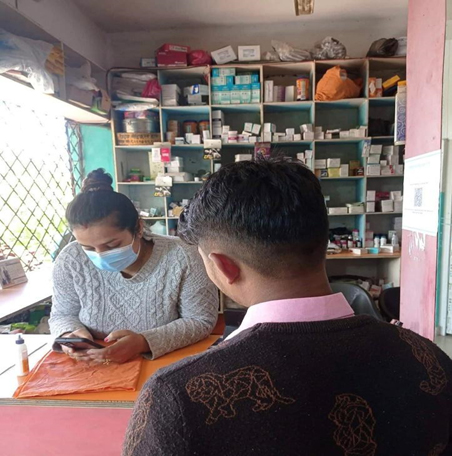
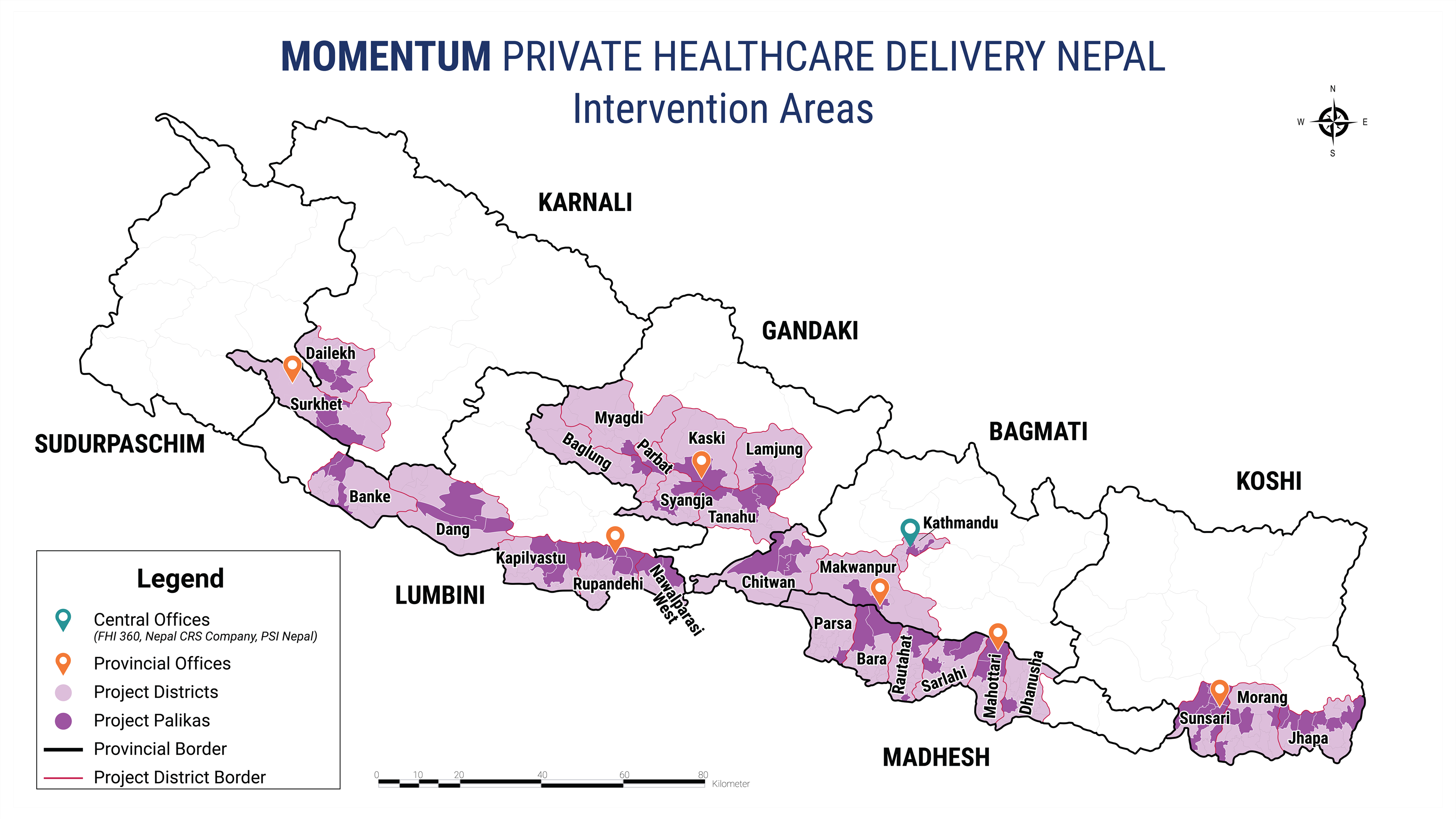
Nepal CRS Company implemented the MOMENTUM Private Healthcare Delivery (MPHD) project in 67 municalities across six provinces of Nepal from May 2021 to January 2025. The project was part of the broader suite of innovative awards under the MOMENTUM initiative, funded by the U.S. Agency for International Development (USAID), aimed at holistically improving maternal, newborn, and child health services, voluntary family planning, and reproductive healthcare (MNCH/FP/RH) in partner countries worldwide. The MPHD project supported the expansion of public–private partnerships to strengthen the enabling environment for MNCH/FP/RH in alignment with the overall objectives of the MOMENTUM suite of awards.
In Phase 1 (May 2021–September 2022), MPHD Nepal focused on piloting its Private Sector Family Planning (FP) approach across 105 facilities in seven municipalities. The work emphasized building provider technical capacity through trainings such as ASRH basic training, Sangini network training, PBCC, and Value Clarification and Attitude Transformation (VCAT). Quality assurance/quality improvement (QA/QI) assessments and client feedback mechanisms were introduced to strengthen service delivery. Business skills training (BST) and Health Facility-Initiated Demand Generation (HFIDG) were also provided to improve managerial capacity. Community mobilization activities like Chhalfal Chautari were developed to engage adolescents and youth, while evidence generation and public-private collaboration were initiated through data sharing and municipal/provincial engagement.
In Phase 2 (Years 3–6, October 2022–March 2026), the project shifted toward scaling and sustaining the Private Sector FP approach. MPHD expanded to 811 identified facilities across 60 municipalities, of which 773 were engaged and 738 transitioned to maintenance engagement by Year 4. The focus was on overcoming barriers to private sector FP services, refining and scaling the Phase 1 approach, and catalyzing sustained engagement. Activities included strengthening private sector FP service standards, expanding private sector data entry into the national HMIS, supporting commodity supply chain management, and exploring opportunities for DMPA-SC access and waste disposal improvements. The expansion emphasized sustainability, digital systems integration, and building a cadre of private sector advocates and leaders to ensure long-term impact.
THE GOAL
The goal of the project was to establish a successful business model for the private sector to provide quality FP services to adolescents and young people in Nepal.
OBJECTIVE:
GEOGRAPHIC FOCUS
Key Accomplishments Across MPHD Priority Technical Areas
Private Sector Engagement:
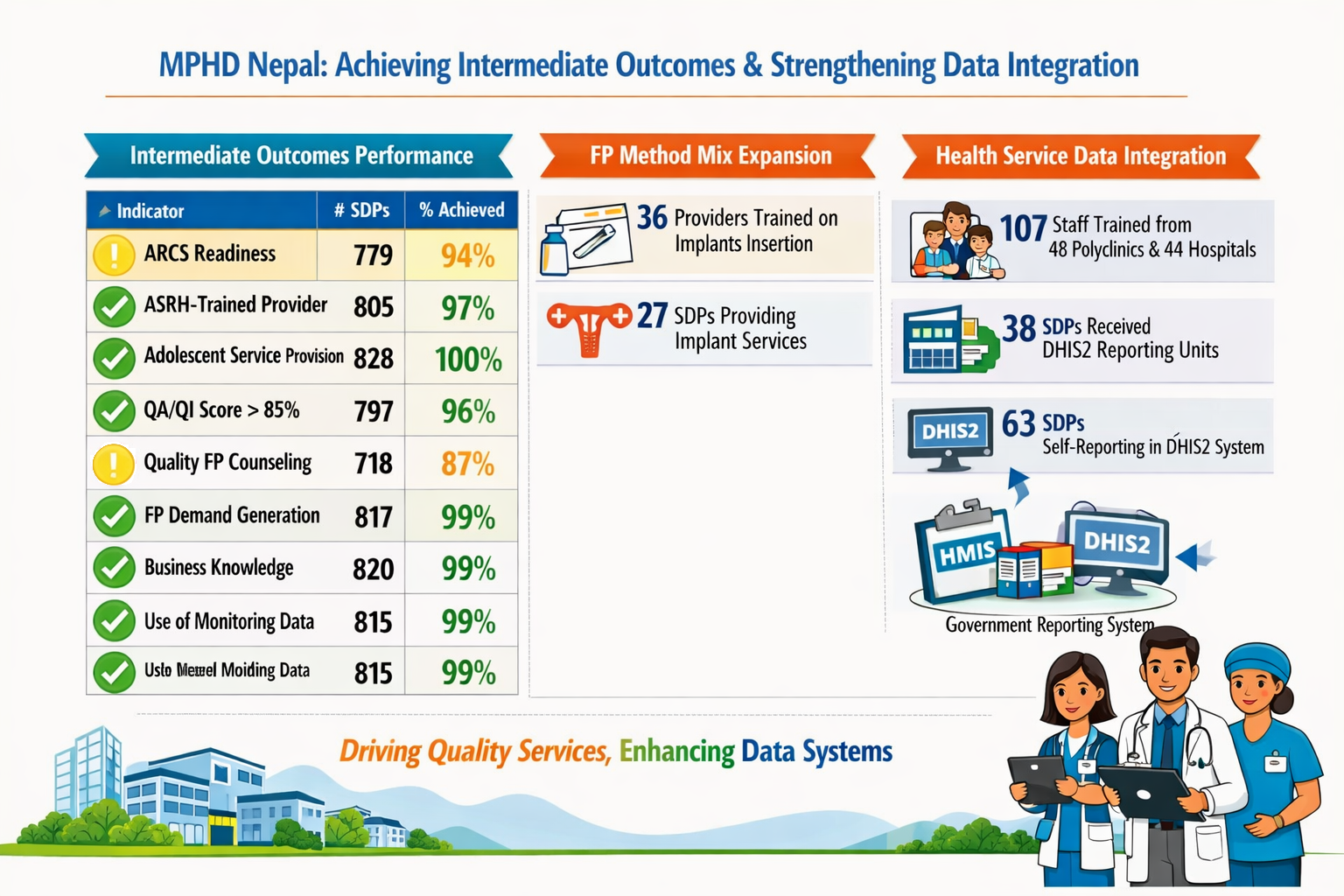
Adolescent responsive contraceptive service (ARCS) readiness was enhanced through continued capacity strengthening of 916 project-supported service delivery points (SDPs) (105 SDPs engaged since PY1-21 and 811 SDPs as part of scale-up in PY32) through training, monthly Quality Assurance/Quality Improvement (QA/QI) assessments, and onsite coaching to help these SDPs deliver quality FP services; carrying out health facility-initiated demand generation (HFIDG) activities; and adopting good business practices relating to business planning, record keeping and financial management. All SDPs were supported to ensure the availability of i) a counseling space to maintain the privacy and confidentiality of clients; ii) at least one adolescent sexual and reproductive health (ASRH) trained provider; iii) ASRH booklets for adolescents; iv) stock of at least four short-acting contraceptive methods; and v) referrals for Long- Acting Reversable Contraceptive (LARC) and permanent methods, to ensure access to a wide range of FP services. To expand FP method-mix in the private sector, selected providers were trained in implant and depot-medroxyprogesterone acetate- intramuscular (DMPA-IM).
Person-Centered Care :

MPHD Nepal created multiple mechanisms to advance person-centered care by collecting clients’ perspectives to inform program-level and SDP-level decision-making.The Person-Centered Contraceptive Counselling (PCCC) scale was included in the online client feedback mechanism and client exit interviews to measure person-centeredness of contraceptive counselling at each SDP. The online client feedback mechanism was institutionalized for all 916 SDPs engaged with the project. Client feedback was also shared with owners and providers through real-time dashboards to collectively resolve challenges to providing high-quality person-centered services.
Localization:
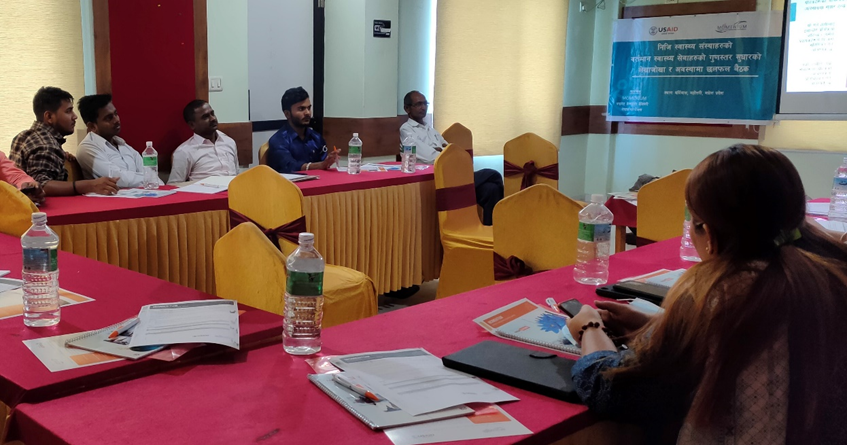
MPHD Nepal engaged with the three tiers of national, provincial, and local governments to strengthen private sector engagement and increase stewardship and collaboration with the private sector providers and owners. The project: i) collaborated with Provincial Health Training Centers (PHTCs) to provide 42 onsite coaching and mentoring visits to improve implant services from private providers; ii) conducted 62 joint monitoring visits with municipality governments to private sector SDPs to promote engagement with municipality health priorities and encourage sustained government monitoring of private sites; iii) supported SDPs to submit their service data to the respective municipal authorities; iv) trained 107 private providers on health service data integration into the government system resulting in SDPs reporting regularly; and iv) conducted quarterly engagements with provincial (16 meetings) and municipal (308 meetings) stakeholders to strengthen public-private linkages.
KEY ACCOMPLISHMENTS THAT DELIVERED RESULTS